

1. Basic Identification Information
| Item | Content |
|---|---|
| Standard Chinese Name | Tafluprost ethyl amide |
| Chinese Aliases | Tafluprost amide, Tafluprost ethylamide, Tafluprost amide impurity |
| Standard English Name | Tafluprost ethyl amide |
| English Aliases | Taflpostamide, Taf EA, Tafluprost EA, Latanoprost Impurity 18 |
| CAS Number | 1185851-52-8 |
| Molecular Formula | C₂₄H₃₃F₂NO₄ |
| Molecular Weight | 437.52 |
| PubChem CID | 71587943 |
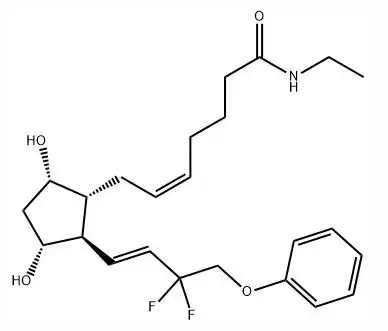
| IUPAC Systematic Name | (5Z)-7-[(1R,2R,3R,5S)-2-[(1E)-3,3-difluoro-4-phenoxybut-1-en-1-yl]-3,5-dihydroxycyclopentyl]-N-ethylhept-5-enamide |
| SMILES Structure | O[C@@H]1C@HC@@HC@HC1 |
Prostaglandin Nomenclature: N-ethyl-9α,11α-dihydroxy-15,15-difluoro-16-phenoxy-17,18,19,20-tetranor-prosta-5Z,13E-dien-1-amide
2. Physicochemical Properties
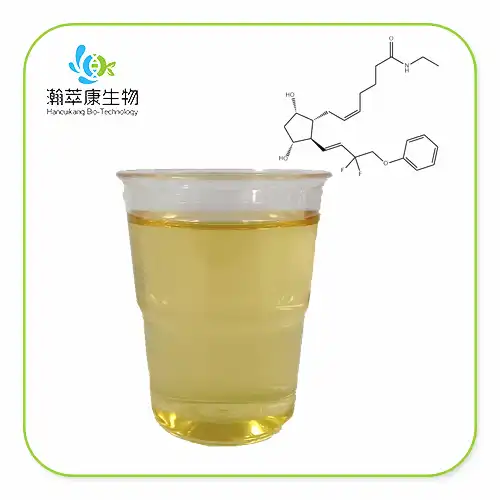
Appearance: Colorless to pale yellow viscous liquidDensity: 1.2 ± 0.1 g/cm³Boiling Point: 609.3 ± 55.0 °C (760 mmHg)Flash Point: 322.3 ± 31.5 °CMelting Point: Not disclosed (liquid at room temperature)
Solubility:
DMSO: ≥30 mg/mL
DMF: ≥30 mg/mL
Ethanol: ≥30 mg/mL
Water: Practically insoluble
Purity: Commercial reference standards/intermediates ≥98%; Pharmaceutical grade ≥99% (HPLC)
3. Pharmacological Effects and Mechanism
Category: Prostaglandin F₂α analog, FP receptor agonist, prodrug
1) Target of Action
It selectively acts on FP receptors (prostaglandin F receptors) with high affinity. It has extremely low affinity for other prostaglandin receptors (EP, DP, IP, TP), featuring high selectivity and low off-target effects.
2) Mechanism of Action (Intraocular Pressure Reduction)
Activation of FP receptors increases aqueous humor outflow via the uveoscleral pathway, thereby lowering intraocular pressure (IOP). It also mildly reduces aqueous humor production, exerting dual effects on IOP reduction.
3) In Vivo Profile (Prodrug Characteristics)
Ethyl amide modification is adopted for prodrug design:It improves lipophilicity and enhances corneal penetration via passive diffusion.After entering ocular tissues, it is hydrolyzed by esterases to form the active ingredient: Tafluprost acid.It is rapidly absorbed in the eye, sustains local efficacy, leads to extremely low systemic exposure and few systemic adverse reactions.
4) Preclinical Pharmacodynamic Data
IOP reduction range: 25–35% (tested in rabbit and monkey models with normal eyes and glaucoma).Onset of action: Peak efficacy occurs 4–8 hours after administration; the effect lasts for 24 hours, suitable for once-daily dosing.
5) Eyelash Growth Effect
Activation of FP receptors on eyelash follicles prolongs the growth phase and increases lash diameter, resulting in thicker, longer and darker eyelashes.
4. Main Applications
1) Pharmaceutical Field
Glaucoma/Ocular Hypertension: Formulated as topical eye drops for IOP reduction; a candidate first-line drug currently in Phase III clinical trials.
Hypotrichosis of Eyelashes: Used in eyelash growth serums and compound ophthalmic/cosmetic preparations.
Pharmaceutical Intermediate: A key intermediate for the synthesis of Tafluprost and its analogs.
2) Cosmetic Field
Low-concentration formulations for eyelash nourishment and growth serums.
3) Research Applications
FP receptor research tool, ophthalmic pharmacology reagent, reference standard and impurity reference standard.
5. Preparations, Concentration and Storage
1) Common Preparations (Research & Commercial Trials)
Eye drops: 0.001% (10 μg/mL)
Eyelash serum: 0.003%~0.01%
Reference standard solution: 10 mM in DMSO (stored at -80℃)
2) Stability and Storage Conditions
Pure solid/liquid substance: Stable for 1 month when stored at -20℃ protected from light; stable for 6 months when stored at -80℃ protected from light.
Solutions (DMSO/Ethanol): Long-term stable at -80℃ protected from light; avoid repeated freeze-thaw cycles.
Eye drops: Refrigerate at 2–8℃; use up within 4 weeks after opening.
6. Safety and Toxicology (Preclinical Data)
Ocular tolerance: Well tolerated. Mild conjunctival congestion (5–10%), dry eyes and foreign body sensation are common adverse reactions, which are mostly transient.Systemic toxicity: Extremely low due to minimal systemic exposure; no obvious adverse reactions on cardiovascular, respiratory and digestive systems.Reproductive and Genotoxicity: No teratogenicity or mutagenicity observed in preclinical studies (limited data available).Contraindications: Use with caution in patients allergic to prostaglandins, patients with active intraocular inflammation, pregnant women and breastfeeding women.
Additional Preparations Details
I. Investigational Ophthalmic Preparations (for Glaucoma/Ocular Hypertension, Core Applications)
1) Eye Drops (Main Formulation)
Concentration: 0.001% (10 μg/mL), consistent with Tafluprost.Excipients: Polysorbate 80, glycerin, disodium edetate, phosphate buffer solution, water for injection; generally preservative-free in single-dose sterile packaging.Packaging: 0.3 mL per unit in aluminum foil single-dose sachets; dosage: 1 drop once daily.Development status: Phase III clinical trial for open-angle glaucoma and ocular hypertension.
2) Ophthalmic Gel/Suspension (Long-acting Investigational Formulation)
Concentration: 0.001%~0.003%Features: Formulated with carbomer/hyaluronic acid matrix to extend ocular residence time; administration interval can be extended to once every 2 to 3 days.Development stage: Preclinical study / Early Phase I clinical trial.
3) Intraocular Implant (Sustained-release, Exploratory Stage)
Carrier: PLGA microspheres / biodegradable polymer rodsDrug loading: 50~200 μg per implant; sustained drug release for 3 to 6 months.Development stage: Preclinical animal experiments.
II. Eyelash Growth & Cosmetic Preparations (Low-concentration, Cosmetic Grade)
1) Eyelash Essence (Most Widely Used)
Concentration: 0.003%~0.01% (30~100 μg/mL)Matrix: Water, glycerin, hyaluronic acid, panthenol, phenoxyethanol, etc.Application: Apply to eyelash roots every night; visible effects appear after 4 to 8 weeks of use.Development status: Classified as non-pharmaceutical cosmetic raw material. Sold by niche brands in Europe, America and Southeast Asia; not approved as a new cosmetic raw material in China.
2) Compound Eyelash Mascara/Eyebrow Pomade
Concentration: 0.001%~0.002%Formula: Added into mascara to combine coloring, nourishing and growth-promoting effects.Development status: Laboratory formula / small-batch custom production.
III. Pharmaceutical Raw Materials & Research Reference Standards (Laboratory & R&D Use)
1) Active Pharmaceutical Ingredient (API)
Purity: ≥98% (industrial grade), ≥99% (pharmaceutical grade / HPLC grade)Appearance: Colorless to pale yellow viscous liquidPackaging: 1 g/bottle, 5 g/bottle, 10 g/bottle (store at -20℃ protected from light)
2) Reference Standard / Impurity Reference Standard
Concentration: 10 mM (approx. 4.38 mg/mL) dissolved in DMSO/EthanolPackaging: 1 mL per ampoule; stored at -80℃Application: HPLC assay, content determination and impurity identification
3) Research Solutions
Solvents: DMSO, DMF, Ethanol (solubility ≥30 mg/mL)Concentration: 1 mg/mL, 5 mg/mL, 10 mg/mLApplication: Cell experiments, receptor binding assays and animal administration